GA Freight Limited
Incoterms
What Are Incoterms Rules?
The Incoterms rules (International Commercial Terms) are the world’s essential terms of trade for the sale of goods. Published by the International Chamber of Commerce (ICC) and updated periodically—most recently as Incoterms 2024—they provide a universal language and set of rules that define the responsibilities of buyers and sellers in international transactions.
Whether you are filing a purchase order, packaging and labelling a shipment for freight transport, or preparing a certificate of origin at a port, the Incoterms rules are there to guide you. These internationally recognised standards provide specific, unambiguous guidance to the millions of individuals participating in the import and export of global trade on a daily basis.
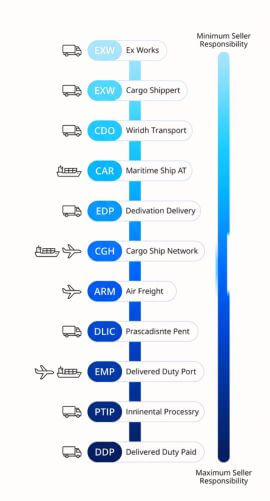
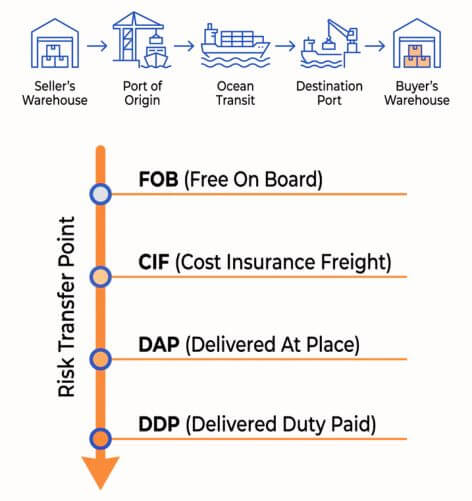
Incoterms rules serve three critical functions in global trade:
Why Incoterms Matter
Clarity of Responsibility
Clearly defines who is responsible for each stage of transport, from collection to final delivery.
Cost Allocation
Specifies which costs are borne by the seller and which by the buyer—including transport, insurance, and customs duties.
Risk Transfer Point
Determines the exact moment when risk transfers from seller to buyer, protecting both parties in case of loss or damage.
By agreeing on a specific Incoterm rule in your sales contract, both parties share a precise, legally recognised understanding of their obligations—reducing the potential for costly disputes.
Incoterms rules serve three critical functions in global trade:
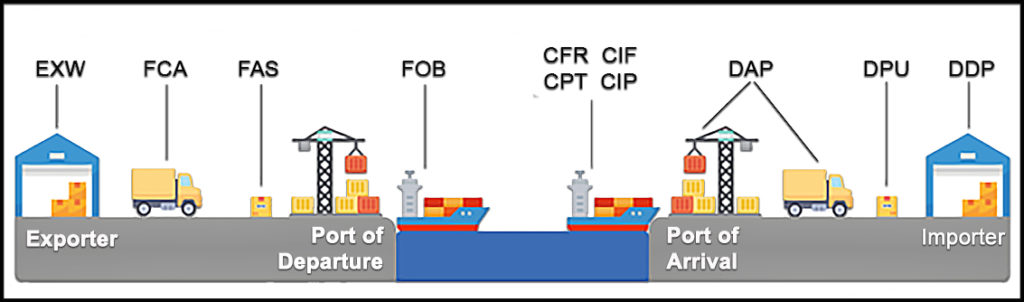
Incoterms are divided into two categories based on the method of delivery: rules for any mode or modes of transport and rules for sea and inland waterway transport only.
Rules for Any Mode of Transport
These seven terms can be used regardless of the transport mode—whether by road, rail, air, or multimodal (combining several methods).
Incoterms
EXW – Ex Works (named place of delivery)
The seller makes the goods available at their premises (factory, warehouse, or farm). The buyer bears all costs and risks involved in taking the goods from that location to the final destination.
Seller’s Responsibility: Make goods available at agreed location.
Buyer’s Responsibility: All transport, export/import clearance, and costs from collection onwards.
Best for: Domestic transactions or buyers with established logistics operations.
FCA – Free Carrier (named place of delivery)
The seller delivers the goods to the carrier or another person nominated by the buyer at the seller’s premises or another named place. The seller is responsible for export clearance.
Seller’s Responsibility: Deliver goods to buyer’s nominated carrier and clear for export.
Buyer’s Responsibility: Main carriage, import clearance, and all costs thereafter.
Best for: All transport modes where the buyer arranges main carriage.
CPT – Carriage Paid To (named place of destination)
The seller delivers the goods to the carrier nominated by them and pays the cost of carriage to the named destination. Risk transfers to the buyer once goods are handed to the first carrier.
Seller’s Responsibility: Arrange and pay for main carriage; deliver to carrier.
Buyer’s Responsibility: Import clearance, delivery from arrival point, and all risks after initial delivery.
Best for: Situations where seller arranges transport but buyer assumes risk early.
CIP – Carriage and Insurance Paid To (named place of destination)
Similar to CPT, but the seller also procures and pays for cargo insurance against the buyer’s risk of loss or damage during carriage.
Seller’s Responsibility: Arrange and pay for main carriage and minimum insurance cover.
Buyer’s Responsibility: Import clearance, delivery from arrival point, and any additional insurance desired.
Best for: Higher-value goods requiring insured transit.
DAP – Delivered at Place (named place of destination)
The seller delivers when the goods are placed at the buyer’s disposal on the arriving means of transport, ready for unloading at the named place. The seller bears all risks and costs involved in bringing the goods to that point.
Seller’s Responsibility: All transport costs and risks to named destination (excluding import clearance).
Buyer’s Responsibility: Unloading, import clearance, and onward transport if required.
Best for: Door-to-door deliveries where buyer handles customs.
DPU – Delivered at Place Unloaded (named place of destination)
Formerly DAT (Delivered at Terminal), DPU means the seller delivers and unloads the goods at the named place. The seller bears all risks and costs of transport and unloading.
Seller’s Responsibility: All transport costs, risks, and unloading at named destination.
Buyer’s Responsibility: Import clearance and onward transport from the unloaded point.
Best for: Deliveries requiring unloading by seller (e.g., construction sites, warehouses).
DAP – Delivered at Place (named place of destination)
The seller delivers when the goods are placed at the buyer’s disposal on the arriving means of transport, ready for unloading at the named place. The seller bears all risks and costs involved in bringing the goods to that point.
Seller’s Responsibility: All transport costs and risks to named destination (excluding import clearance).
Buyer’s Responsibility: Unloading, import clearance, and onward transport if required.
Best for: Door-to-door deliveries where buyer handles customs.
DDP – Delivered Duty Paid (named place of destination)
The seller delivers the goods to the buyer, cleared for import, and not unloaded from the arriving means of transport at the named place. The seller bears all costs and risks, including import duties, taxes, and customs formalities.
Seller’s Responsibility: Everything, including import clearance and duty payment.
Buyer’s Responsibility: Unloading and minimal cooperation.
Best for: Buyers seeking a true “door-to-door” service with no customs involvement.
Rules for Sea and Inland Waterway Transport Only
These four terms are specifically designed for situations where the transport is entirely by sea or inland waterway.
Incoterms
FAS – Free Alongside Ship (named port of loading)
The seller delivers when the goods are placed alongside the vessel at the named port of loading. The buyer bears all costs and risks from that moment onward.
Seller’s Responsibility: Deliver goods alongside the vessel at port.
Buyer’s Responsibility: Loading, main carriage, and all costs thereafter.
Best for: Bulk or breakbulk cargo where seller delivers to quayside.
FOB – Free on Board (named port of loading)
The seller delivers the goods on board the vessel nominated by the buyer at the named port of loading. Risk transfers once the goods are on board. The seller is responsible for export clearance.
Seller’s Responsibility: Deliver goods on board vessel and clear for export.
Buyer’s Responsibility: Main carriage, insurance, and all costs from loading onward.
Best for: Containerised cargo and traditional sea freight transactions.
CFR – Cost and Freight (named port of destination)
The seller delivers the goods on board the vessel and pays the cost of transport to the named port of destination. Risk transfers to the buyer once goods are on board at the port of loading.
Seller’s Responsibility: Arrange and pay for carriage to destination port.
Buyer’s Responsibility: All risks from loading onward, import clearance, and delivery from port.
Best for: Situations where seller arranges shipping but buyer assumes risk during transit.
CIF – Cost, Insurance and Freight (named port of destination)
Similar to CFR, but the seller also procures and pays for marine insurance against the buyer’s risk of loss or damage during carriage.
Seller’s Responsibility: Arrange and pay for carriage and minimum insurance to destination port.
Buyer’s Responsibility: All risks from loading onward (beyond insured value), import clearance, and delivery from port.
Best for: Commodities and traditional sea freight requiring insurance.
GA Freight Limited Your Incoterms Partner
With over 80 years of combined industry experience and three generations of freight forwarding expertise, GA Freight understands that the right Incoterm can make or break an international transaction. We provide clear, practical guidance to help you:
Select the most appropriate Incoterm for your specific shipment.
Understand your obligations under each rule.
Avoid costly misunderstandings with trading partners.
Ensure smooth customs clearance at both ends.
Navigating international trade terms doesn't have to be complicated.
Contact GA Freight Limited today for expert advice on Incoterms and a competitive quote for your next shipment. Let our generations of experience guide your global trade.
Common Shipping Container Types
Your Container Experts
GA Freight Limited
Standard
Standard Dry Containers (General Purpose)
The workhorse of global trade, standard dry containers are used for the vast majority of general cargo. They are fully enclosed and weatherproof, designed for goods that do not require temperature control.
20ft Container: Ideal for heavier, denser cargo. Maximum payload typically ~28 tonnes.
40ft Container: Perfect for lighter, bulkier cargo. Maximum payload typically ~26 tonnes.
40ft High Cube (HC): Provides an extra foot of height (9’6″ vs 8’6″), ideal for voluminous but lightweight goods.
Best for: Boxed goods, palletised cargo, machinery parts, furniture, textiles, and general merchandise.
GA Freight Limited
High Cube
High Cube Containers
These are identical to standard containers but offer an additional 1 foot (30cm) in height. This extra space is invaluable for tall or awkwardly shaped items and can significantly improve loading efficiency for certain cargo types.
Best for: Voluminous cargo, tall machinery, lightweight manufactured goods.
GA Freight Limited
Open Top
Open Top Containers
When cargo is too tall or awkwardly shaped to fit through a standard container door, an open top is the solution. These containers have a removable tarpaulin roof, allowing loading from above via crane or forklift.
Best for: Heavy machinery, marble slabs, timber, scrap metal, tall equipment, and project cargo.
GA Freight Limited
Flat Rack
Flat Rack Containers
Flat racks consist of a strong floor base with collapsible end walls. They are designed for over-dimensional, heavy-lift, or awkwardly shaped cargo that cannot fit inside a standard enclosed container.
Fixed End Flat Rack: End walls remain upright for added security.
Collapsible Flat Rack: End walls fold down for storage when empty.
Best for: Construction equipment, vehicles, boats, pipes, industrial machinery, and large steel structures.
GA Freight Limited
Open Side
Open Side Containers
Also known as “full side access” containers, these feature double doors on the long side in addition to the standard end doors. This provides forklift access from the side, making loading and unloading wider items much easier.
Best for: Long pipes, timber, building materials, and cargo requiring side loading access.
GA Freight Limited
Reefer (Refrigerated)
Reefer Containers (Refrigerated)
Reefer containers are temperature-controlled units that maintain a consistent internal climate, from frozen to chilled. They are equipped with integrated refrigeration units and require a power source onboard the vessel or at the terminal.
Best for: Perishable food (fruit, vegetables, meat, fish), pharmaceuticals, chemicals, and flowers.
GA Freight Limited
Tank
Tank Containers
Designed specifically for the safe transport of bulk liquids, tank containers consist of a cylindrical tank housed within a standard container frame.
Best for: Food-grade liquids (wine, oils, juices), chemicals, fuels, and hazardous liquids.
GA Freight Limited
Insulated
Insulated Containers
Similar to reefers but without active refrigeration, insulated containers maintain the temperature of pre-conditioned cargo. They are often used for goods that must remain within a specific temperature range but do not require continuous cooling.
Best for: Temperature-sensitive goods in moderate climates, chocolate, certain chemicals.


team
With a Professional Team

Alan Bishop

Alan Bishop